If you're thinking about adding a journal to your product line, it probably feels like a natural next step. And it is! But while journals and planners may look similar, the design process behind them is surprisingly different. The content is different. The interior page structure is different. The paper is different. Even the binding decision changes.
In this post, I'll walk you through what custom journal design actually looks like, from our very first discovery call to the day your print-ready files are delivered. And if you're wondering what a planner product designer actually does, you may want to start there—it'll give you helpful context before we dive into the journal-specific process below.
What Counts as a Journal — And Why It Matters
There's a lot of overlap between journals and planners, but the distinction matters because it changes how we design. When I talk about journals in my design practice, I sort them into a few distinct types:
Guided journals — Filled with thoughtful prompts or questions that gently guide each writing session. These are perfect for gratitude, manifestation, self-reflection, or therapeutic journaling.
Blank journals — Completely open pages with no prompts or structure, giving your customers the freedom to use them however they like. Without much design on the page, beautiful paper and subtle typography will be the focus of your design decisions.
Prompted journals — A happy medium between guided and blank journals. Each page includes a simple prompt, quote, or small illustration to inspire ideas while still leaving plenty of room to write.
Gratitude journals — Designed for quick daily reflection, with space to capture a few thoughts or moments of gratitude each day. They're often compact, lightweight, and easy to take anywhere.
Prayer or spiritual journals — Created for prayer, scripture study, or personal reflection, with calming layouts and generous white space that encourage a peaceful writing experience.
Art journals — Made for sketching, painting, collaging, and creative expression. These journals typically feature heavier paper and open layouts without lines or rigid structure.
Each type demands a different interior structure, paper weight, and marketing angle. They're not interchangeable in design or price, which is why it’s important to understand the design process.
Not sure where to start? Download the free checklist → to organize your journal concept before reaching out to a designer.
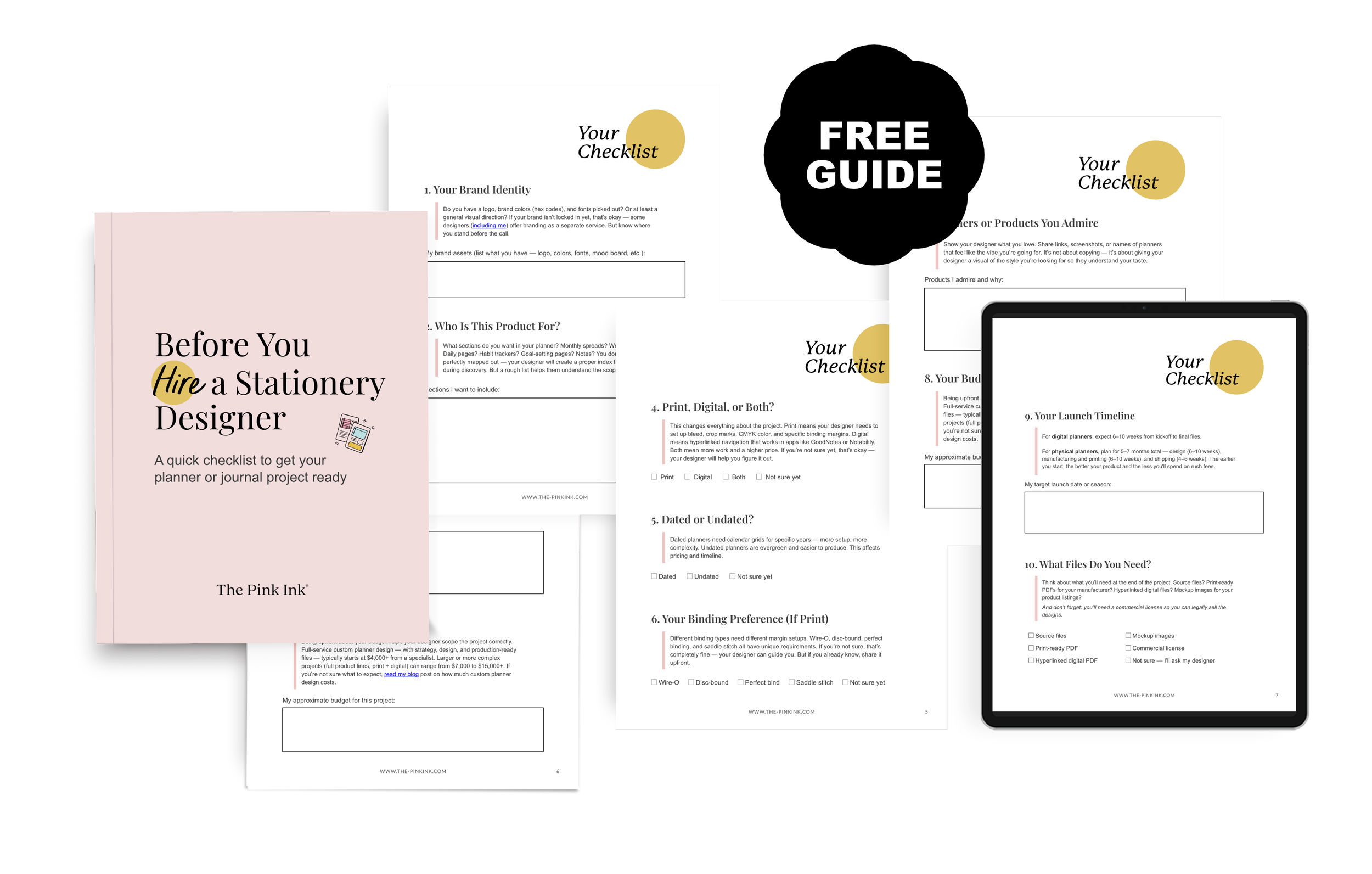
DOWNLOAD THE CHECKLIST »
What Does the Journal Design Process Look Like Step by Step?
Stage 1: Discovery – Understanding Your Journal Concept
When a brand comes to me saying “I want to launch a journal,” the first conversation is all about digging into what that means specifically. What kind of journal is this? Who's your audience? What's the content strategy? For how long is it intended to be used? What format and size feel right?
From these conversations, I build a rough page map complete with the cover, interior pages with repeat counts, any divider sections, and finally special pages like an introduction or index. This becomes the foundation for everything that comes next. If you want to understand how page maps work in detail, you can read my guide on what to include in your planner index file.
Stage 2: Strategy – Positioning Your Journal in the Market
Every successful journal starts with a clear strategy. Unlike planners, which are often organized around dates and productivity, journals are built around a specific purpose or experience. That means your positioning influences everything that follows—from the type of journal you create and the audience it's designed for to the interior structure, branding, and overall customer experience.
During this stage, I'll research other journals in your niche, identify opportunities to help your product stand out, and work with you to define your target audience, positioning, and pricing strategy. If you’re wondering how much custom planner design costs, I've covered the biggest pricing factors in my planner design guide, many of which apply to journals as well.
Stage 3: Design – Creating Pages That Invite Use
Unlike planner design, which is about functionality and navigation, journal design is about creating a feeling. For the cover, I'm thinking about luxury and approachability. For the interior, I'm designing with the user's experience in mind: typography, whitespace, subtle visual elements, page variety, and rhythm.
For guided journals, I work with your prompt content to ensure the layout supports how customers will use your product. Every choice—prompt placement, spacing, illustration—affects the experience.
Stage 4: Delivery – Print-Ready Files and Binding Strategy
Once designs are approved, I prepare production files: CMYK color conversion, proper bleed and trim marks, binding specifications, and mockups. For journals, binding choice is especially important—perfect bind, saddle stitch, and Wire-O each serve different purposes. To get a feel for what the full process looks like in action, check out how to prepare for your first call with a planner designer.
Why Is Journal Design Part of Your Unlimited Design Subscription?
If you're growing a stationery brand, journals are a natural next step. And if you're working with me on an unlimited design subscription, journal design is completely built in. We plan your journal alongside your planner editions, handle the full design process, and deliver production-ready files. You're not hunting for a new designer or renegotiating contracts.
A journal is also a chance to deepen your brand story. Your planner helps people organize. Your journal helps them reflect. Together, they create a complete daily practice for your audience.
💌 Interested in working with The Pink Ink to create your custom planner or journal?
Fill out an inquiry form to start the conversation, share your project details, and help me determine if we’re a good fit for each other.
Ready to Expand Your Product Line?
If you’re thinking about adding journals, notebooks, or workbooks to your brand, here’s how I can help:
→ Want every page designed from scratch? My custom planner design service covers journals and notebooks too — strategy, design, production files, all of it.
→ Launching multiple products? An unlimited design subscription keeps one designer across your entire line so everything stays cohesive.
→ Need your brand foundation first? My custom branding service builds the visual identity that makes every product feel like yours.
→ Want professional templates to customize? My PLR membership gives you designer-quality journal, notebook, and planner templates — bring your brand and make them yours.
→ Want to learn how to design these yourself? My Services Mastery course teaches you the full process — from discovery through design and delivery.
Not quite ready? Download the free checklist →