How to Earn $5k from Digital Planner Sales
Welcome to another week of our 60-day setup series! If you’ve been following along, you know that we’re spending each week of the remainder of the year tackling a goal that will set your shop up for success in 2026. This week, we’re diving into the scaling stage of owning a digital stationery shop by talking about four steps you can implement that will take your shop from just getting started to consistently profitable:
Study the trends
Build your product collection
Add a niche
Diversify your marketing
So, how do you actually start scaling? It all begins with understanding the trends shaping your niche.
1. Study the Trends
By studying trends in the digital stationery niche, you can get a good idea of what kinds of products people are interested in and what you can do to set your business apart. To study trends, look at the following areas:
Check out other Etsy shops and social media to see what's resonating with customers
Read reviews and comments to identify what people love and don't love
Keep an eye on current events and pop culture that influence your audience
Develop unique ideas that create not just trendy products, but timeless ones as well
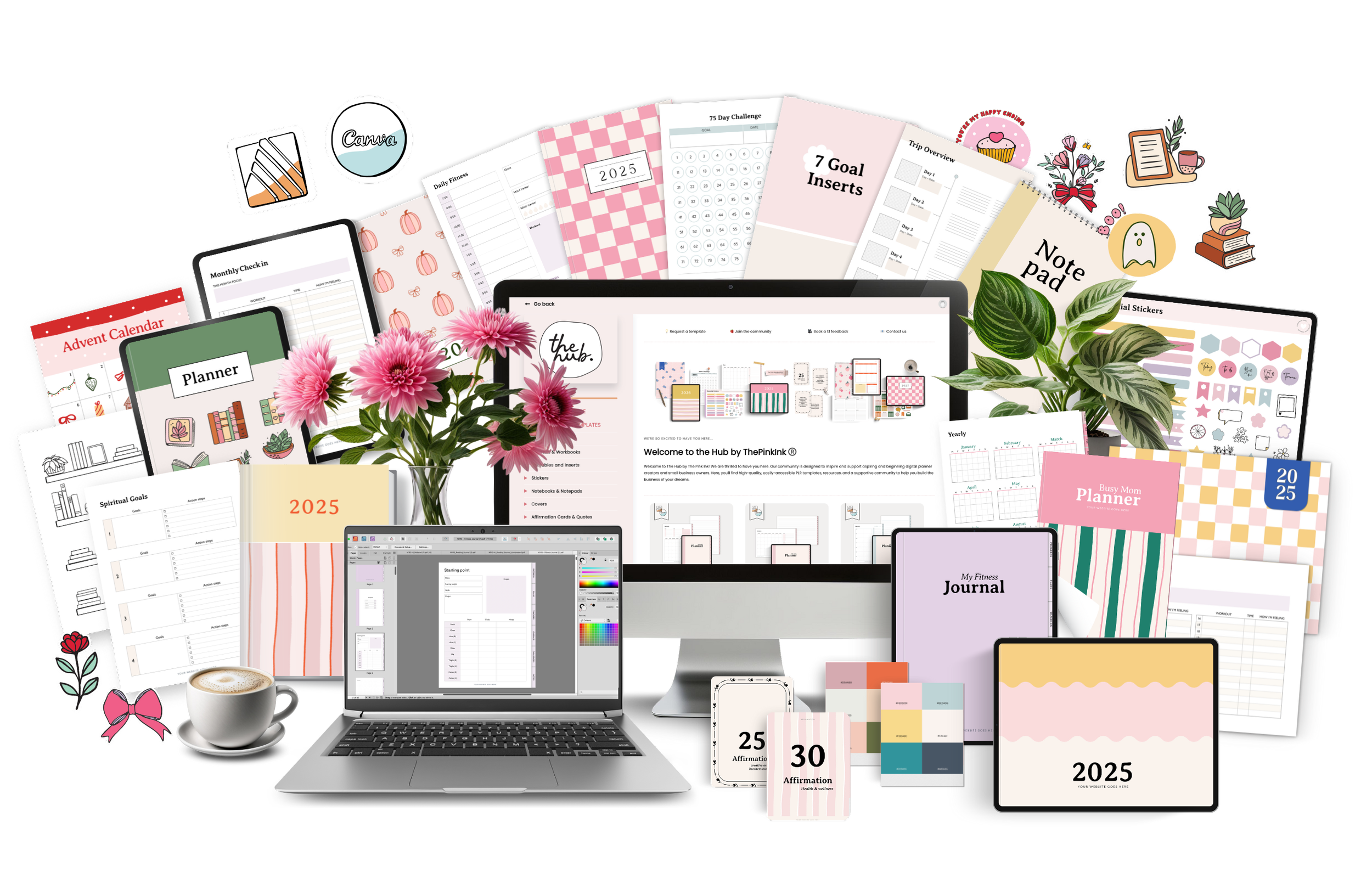
One of the monthly highlights inside The Hub, our monthly PLR template membership, is a trend report that drops at the beginning of each month that highlights what products are at the top of search results, which keywords are seeing more searches, and what this can mean for your business.
For this week only, you can join The Hub for just $299 a year – and not only on the yearly plan, but choose to join on a quarterly or monthly basis as well! You can learn more about what’s included in a membership to The Hub by clicking here.
Staying up to date on the latest trends can be fun and a great inspiration as you work on creating your next collection!
Stop the Feast-or-Famine Sales Cycle
The Hub gives you fresh monthly PLR templates to sell, proven marketing strategies, and exclusive workshops—everything you need for consistent income.
2. Build Your Product Collection
A digital product collection is like a bundle of your customer’s favorite products with a central theme. Sometimes collections are created to help users accomplish a specific goal or have a certain aesthetic that appeals to your niche or the time of year. They complement each other and work together to form a well-rounded digital library of products! Not to mention, customers often love them a little more for being available at a slightly discounted price than if they were to add each product to their cart individually.
The benefits of creating a collection?
They create loyal customers
Increases your average order value
And last but not least, gets you closer to your goal of $5k sales
If those benefits sound like exactly what you’ve been wanting for your shop, the next step is learning how to put a collection together the right way. Here’s where to start:
How to build a collection
Create a mood board to set the aesthetic tone
Select your colors and fonts for consistency
Choose elements that add personality and help you stand out
Build reusable patterns for easy page duplication
Test products together before launching
Outsource by purchasing templates with a commercial license
The truth is, collections can be a lot of work. Especially if you’re building every product from scratch, you may be wondering when you’ll find the time to make this happen. But hope isn’t lost! Templates are your best friend. They can turn into a polished, sellable product in just a few hours.
Instead of staring at a blank page wondering where to start, a template gives you the structure, layout, and design foundations you need. All that’s left is customizing the colors, fonts, and little details—something The Hub teaches you how to do step-by-step.
And if you’re looking to build a full collection without burning out or blowing your budget, template packs and subscriptions make it easy. Inside The Hub, you’ll get fresh PLR templates, graphic packs with 20+ hand-drawn illustrations in multiple styles, and files you can scale, remix, and resell with a commercial license. Updated monthly.
For a limited time, you can join The Hub for $299 annually (regularly $315), with monthly and quarterly options if you prefer. It’s the easiest way to create more products, faster—and finally fill your shop with designs you're proud of. Snag the deal here!
3. Add a Niche
This is best to do when you have an idea and a bit of interest in the second niche that interests you. To maintain the audience you currently have, poll your followers and warm leads to see what they think of your new idea. Take their feedback and adjust accordingly. Revisit your brand's mission statement, messaging, and business plan. Will adding this niche to your business bring you closer to your goals?
Pro tip: Make sure that there is a need and a gap in the market for the products you want to create and sell. At The Pink Ink, we focus on solution-based products. We take a problem that our ideal client is experiencing, then engineer a product that solves it. You can do the same thing to increase your reach strategically!
Think about this example when it comes to adding a niche to your business:
You're selling digital planners for students and have had great success, but keep noticing and hearing things about the teachers and their lack of a custom digital planner. There may already be teachers in your audience, ones following along with your business in hopes of helping their students. If that's the case, polling your audience and seeing how many teachers there are interested in purchasing their own digital planner may help you add another niche to your business that moves you closer to your goals while helping more people!
Your next steps:
Start with the idea that calls your attention the most and casually test it with your audience through a quick poll or question box.
Listen closely to the feedback you get and look for patterns, not just yes-or-no answers.
Revisit your mission, messaging, and long-term goals and ask, “Does this new niche actually move me forward?”
Do a quick market scan to be sure there’s a real need and a gap you can fill with a solution-based product.
If the interest is there, map out a simple first product to test the niche before going all in.
4. Diversify Your Marketing
Once your products are ready, your next job is making sure the right people actually see them. If you only launch a few times a year, every launch needs intention behind it. Marketing isn’t just posting and hoping for the best, it’s about building momentum before your products ever go live.
Here’s how to make it happen: start by choosing a few core platforms to focus on and staying consistent with them. Pinterest, Instagram, and Etsy SEO should be your main priorities in the early stages. Let’s talk about each one in a bit more detail:
Pinterest works like a long-term traffic driver. Think of it as a search engine instead of social media. Set up a business account, create keyword-focused boards that match your niche, and publish pins that lead directly to your products. These can continue to bring traffic for months after you post them!
Instagram helps you build trust faster. Use it to show your products in action, share behind-the-scenes content, and educate your audience. Focus on short-form video, high-quality visuals, and clear messaging about what you sell and who it’s for. This will increase your visibility and forge stronger connections with your potential customers.
At the same time, make sure your Etsy listings are working for you. The very platform that you’re selling on can also be working for you! Strong SEO helps your products get found when buyers are actively searching. Use clear keywords in your shop title, product titles, descriptions, and tags so your listings show up in the right searches.
Once you’ve gotten your marketing in tip-top shape so that you’re getting as many eyes as possible on your shop, it’s time to give them a reason to buy from you.
Whether you can tell that your audience is ready to invest, you’re launching a new product, or dropping that collection we talked about earlier, create a flash sale to create urgency. Even a small discount gives buyers the extra push they need to purchase. Sales also help you land reviews faster, which builds credibility in your shop! And that’s just another step on the road to make $5k sales.
What comes next as your audience begins to grow? It’s time to make your audience feel valued and appreciated so they see your products as truly valuable. To do this, try treating your email list like your VIP space. Give subscribers early access to your launches, exclusive discounts, or bonuses. This keeps your audience warm and makes your launches more predictable and profitable over time!
Your launch doesn’t have to be complicated. A simple plan can look like:
Build excitement with behind-the-scenes content
Offer early access or a small bonus to your email list
Add a countdown to your launch date
Open with a limited-time incentive like a flash sale
Once you see how simple a launch can really be, the next step is turning that plan into real momentum. You don’t need to overhaul your entire business overnight. Instead, small, focused actions will build consistency, confidence, and results over time. That’s where this week’s priorities come in:
Choose one platform to improve this week (Pinterest, Instagram, or Etsy SEO)
Optimize one product listing with better keywords
Plan one small promotion for your next product or collection
Marketing doesn’t need to be overwhelming. With consistent effort and a simple launch strategy, you’ll start to see more steady traffic, stronger sales, and a clearer path to reaching your $5k goal!
5. Evaluate, Improve, and Repeat
Hitting your first $5K in digital planner sales isn’t about one lucky launch. Last week, we talked about how building systems for your business can help you take back your time so you can focus on what really matters. By doing the four things that we’ve discussed in this article, you’re building momentum through a simple, repeatable process. To recap, this is what you can get started on this week to make 2026 the year you hit all your sales goals:
You study the trends so you’re creating with demand in mind.
You build collections that increase your order value and brand consistency.
You add a niche so your shop grows with intention, not guesswork.
And you diversify your marketing so your products don’t rely on a single traffic source.
Each step builds on the last—and when they work together, that’s when real growth happens.
For this week only, you can join The Hub and save on the annual plan and get instant access to our full PLR template library, training, and monthly resources to help you create, launch, and scale with confidence. Annual, quarterly, and monthly options are available while spots last.
Your next $5K milestone isn’t about doing more—it’s about doing these four things better, again and again, with the right resources behind you.
And you don’t have to build it alone. Learn more and subscribe here.