By now you know what custom planner design costs. But in my experience, the real question isn't the price. It's the value. Is it worth it?
The honest answer isn’t yes or no.
The truth? It depends on what you're building. Let me show you what you get, how to think about ROI, and whether a professional design investment makes sense for your brand right now.
What's Actually Included When You Work With Me
First, let's be clear about what you're getting when you hire a specialist. Here's what my custom planner design packages cover:
Discovery brief with full page mapping (AKA index file) and creative direction
Strategy presentation with market research, audience analysis, and product positioning
Mood board, color direction, and font selection with reasoning
Cover design and interior layout design for all unique pages (not from a template)
Two to three rounds of revisions
Production-ready files (print, digital, or both)
Mockup images for your product listings
Full commercial license — you own the rights to produce and sell
Post-delivery support
That's a LOT. But let's break down what each of these actually means in terms of work and value:
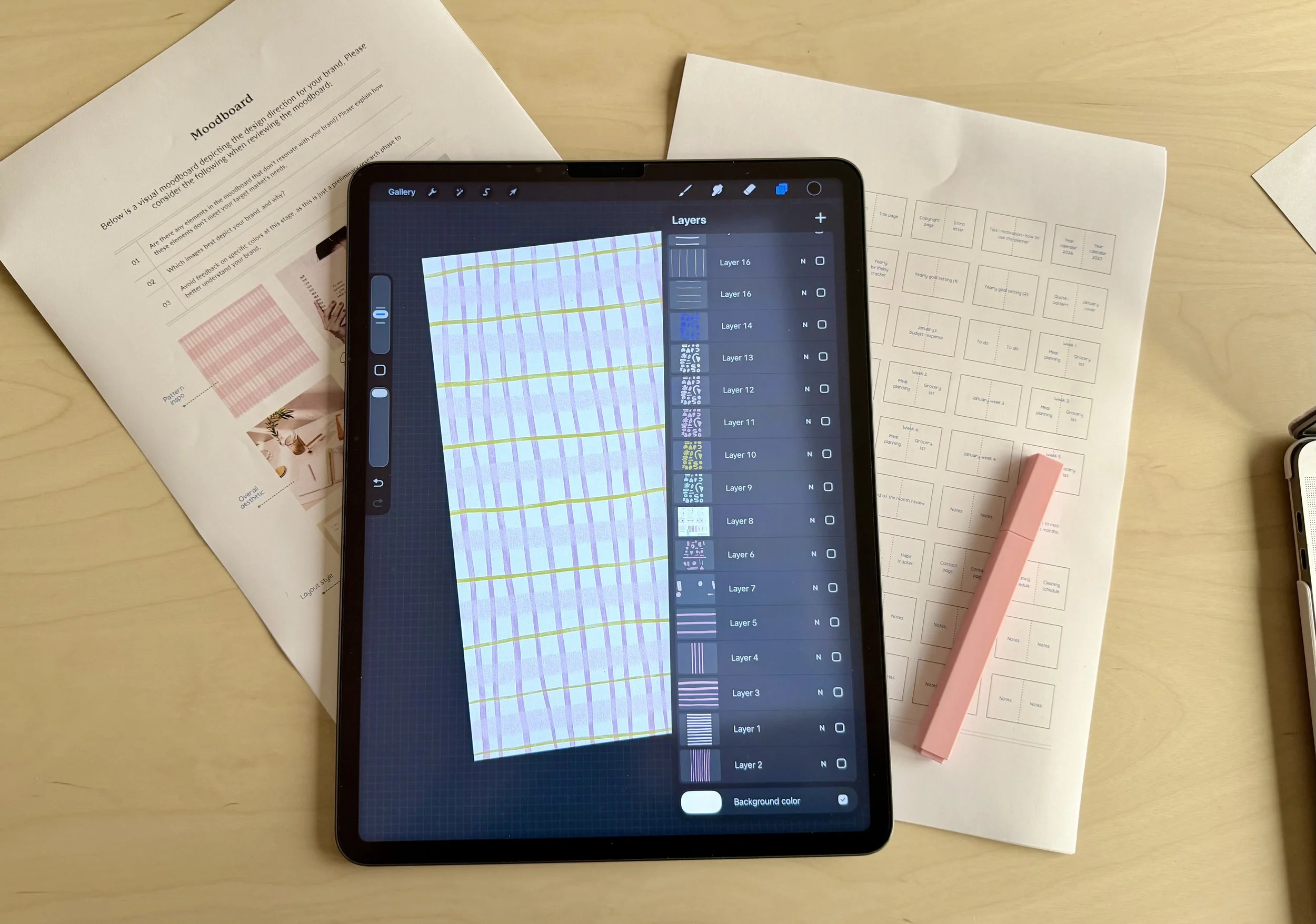
The discovery and strategy phases alone represent 5-10 hours of thinking, research, and presentation work. This isn't design time yet — it's the work that makes the design possible. I'm learning your brand, researching your competitors, analyzing your customers, identifying market gaps, and thinking through positioning. This work is what sets us up for success!
The design phase is 20-30 hours of page creation and refinement. Every unique layout — your cover, your monthly spread, your weekly layout, your trackers, your goal pages — gets thoughtfully designed to form a consistent and beautiful product. If you have 30+ unique page templates (not uncommon for a full planner), that's hours of work per template.
Production prep is another 3-4 hours that most people completely underestimate. If you're printing, I'm building proper bleeds, crop marks, color profiles, and so on. If you're digital, I'm building and testing hyperlinks, optimizing file size, and creating mockups. This isn't glamorous work, but it's what prevents your planner from coming back from the printer ruined or launching with broken navigation.
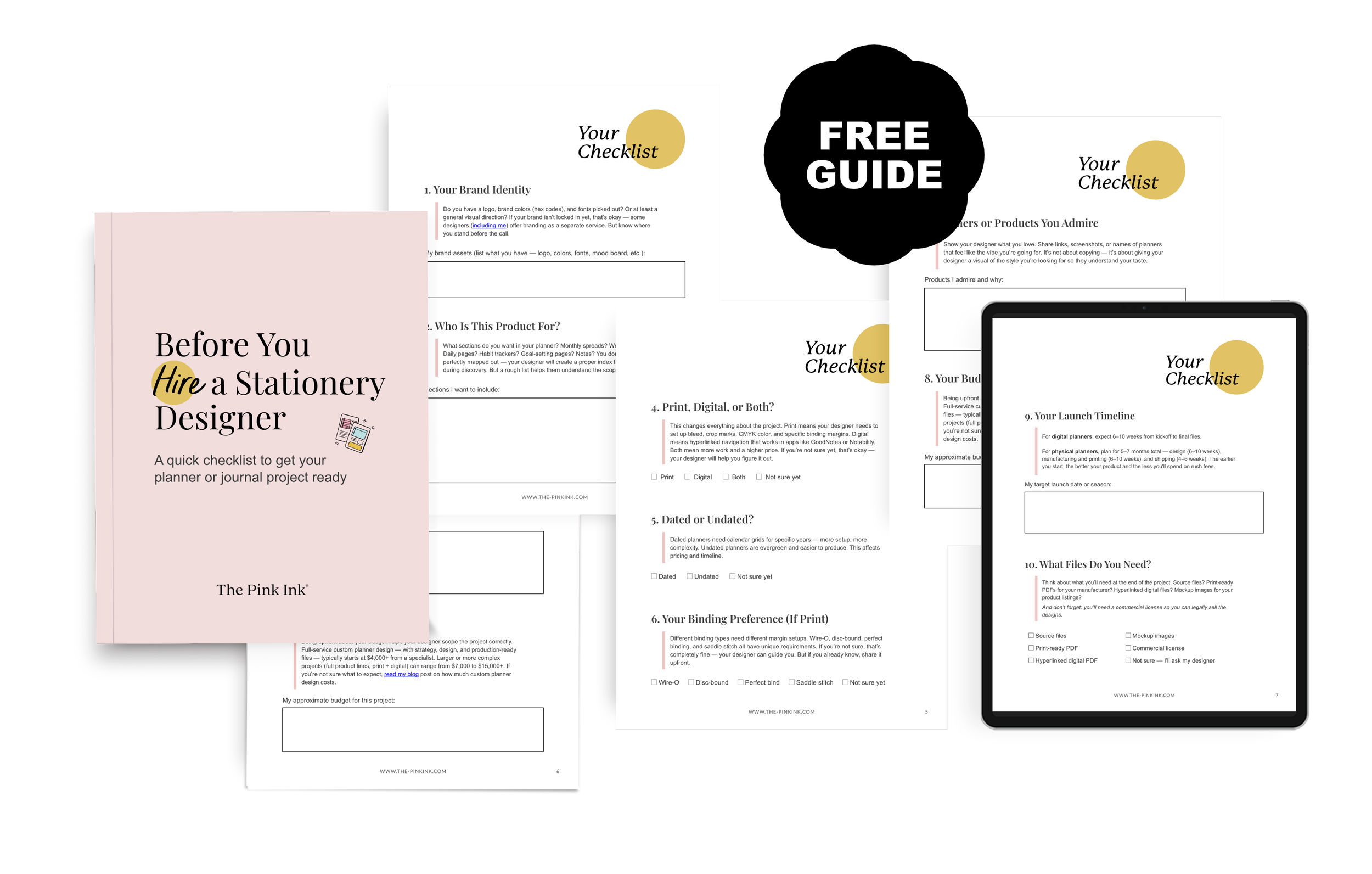
📋 Find our exactly what to expect from a professional designer in my free checklist that breaks down what to ask for in every quote. Download the free checklist →
The Real Value of Professional Design
Here’s what most people don’t realize: design isn’t the most expensive part of launching a planner—production is. Which means the real risk isn’t what you spend on design, but what happens after you send your files to print.
If something is off, here’s what happens:
Your printer flags your files (delays your launch)
You pay someone to rush-fix them
Or worse—everything prints incorrectly
And that can get expensive, fast.
A professional designer prevents that stage from becoming a problem. We design print-ready files that take the headache out of the process. You’re not guessing your way through print requirements or hoping everything works—you’re sending files that are built for production from the start.
That alone can protect your timeline, your budget, and your launch.
But there’s another layer most people don’t consider.
Even when a DIY planner does make it to print, it often wasn’t designed to perform. Designing something that looks good is one thing. Designing something people actually use (and buy!) is another.
Without strategy, you end up with a product that feels slightly off. The pages might look nice, but they don’t flow. The planner doesn’t quite match the rest of your brand. It blends in instead of standing out because it wasn’t built with the bigger picture in mind.
Professional design changes that. A planner designed by an expert sells better. It stands out. Customers recognize quality. And what does that do to your value?
Customers are willing to pay more
Your reviews and word-of-mouth improve
You hit your sales goals faster
That’s the value of truly professional design.
What Happens After Delivery (And Where the ROI Shows Up)
This is where a lot of brand owners get stuck. You launch one planner… and then what?
A year later, you need the next edition. Maybe you want to expand into journals, stickers, or packaging. Now you’re back to the same question: do you hire again, try to DIY it this time, or start over with someone new?
This is where thinking beyond a single project starts to matter.
If you’re planning to release new editions or build out a full product line, a design retainer often makes more sense than hiring project-by-project. You’re not just paying for deliverables—you’re building continuity.
With a retainer, you get:
Reserved design time each month for whatever you need
Priority scheduling (no long waits between projects)
A designer who already understands your brand, audience, and goals
Consistency across every product you release
Ongoing strategy, not just one-time execution
And that continuity adds up quickly.
Instead of re-explaining your vision every time, you’re working with someone who already knows what worked, what didn’t, and how to improve the next version. You move faster. The product gets stronger. Your brand becomes more recognizable with each release.
That’s where the long-term value really starts to show.
But even on a single product, the return can be very real.
Let’s say you invest $6,000 in professional design. Your production cost is $5 per unit, and you sell your planner for $35.
Sell 300 units → $10,500 revenue
After production ($1,500), you’ve made $9,000
Sell 500 units → $17,500 revenue
After production ($2,500), you’ve made $15,000
At that point, the design investment isn’t the risk—it’s a fraction of the return.
Professional design doesn’t just give you a finished product. It gives you a product that’s ready to sell, easier to scale, and built to perform from the start.
And that’s the shift: you stop thinking in terms of cost, and start thinking in terms of what your product is actually capable of earning. That’s real ROI.
💌 Interested in working with The PinkInk!
Fill out an inquiry form to start the conversation, share your project details, and help me determine if we’re a good fit for each other.
When DIY a Planner Makes Sense
Like I mentioned before, I fully believe that DIY is the right answer at times. Here’s how to know if DIYing your planner is right for you:
You're testing an idea. If you're not sure your planner concept will sell, building a simple version yourself is a smart way to validate demand before investing in professional design.
You're just getting started. If the budget is tight and your audience is small, it may be a good idea to generate some revenue first. There’s no shame in starting with what you have!
You're making a simple digital product. A basic undated printable or a short digital download doesn't need a full production process. DIY tools handle these well.
You enjoy the design work. Some brand owners genuinely love designing and have the time for it. If that's you and it's not taking away from other parts of your business, keep going!
This is how many great brands start — including planners I made in Keynote that paid my bills for years!
DOWNLOAD THE CHECKLIST »
Is It Worth the Investment?
If your goal is to create a planner that actually sells, scales, and represents your brand well, then yes, custom design is almost always worth the investment.
The design affects how it functions, how it feels in someone’s hands, how it stands out in your market, and ultimately, whether someone buys it (and comes back for the next edition).
Professional design will reduce production issues, shorten your timeline, and give you a product you can confidently sell and grow from.
That said, not everyone is at the same stage of business and the “right” decision depends on where you are right now.
Let’s consider three different scenarios that can influence your decision:
If you’re building a planner business:
Yes, it’s worth it. This is your product. The design directly impacts usability, perceived value, and repeat sales. Investing here sets the foundation for everything that comes next!
If you’re still testing an idea:
Maybe not yet. Build a simple version yourself, validate that there's demand, and then invest in professional design once you know the concept works. Many strong brands start this way—what matters is knowing when it’s time to level up.
If you’re already selling and want to scale:
A retainer is often the smartest move. You get consistent design support, faster turnaround, consistent quality, strategic thinking, and a product line that feels cohesive.
I’ve seen this from your side of the table.
I started at $300. Now my average project is $6,000–$9,000. That growth happened because I invested in learning the full process — strategy, design, production — and my clients invested in having it done right.
Every single one of them will tell you the same thing:
The product didn’t just get finished. It sold.
📋 Ready to take the next step? Download my free checklist to organize your project details — it'll make the quoting process so much faster. Download the free checklist →
Ready to invest in professional design? I'm here. My custom planner projects start at $4,000 and include everything from discovery to delivery. You need ongoing support, my design retainer gives you a dedicated designer every month. Let's talk about what's right for your brand →
Still exploring? Browse the blog for free resources, check out how to earn $5K from digital planner sales, or see the Jessica's Journals case study to watch a professional project from start to finish.